Bachelor's Program
The Department's bachelor's program offers four admission channels — Star Program Admission, Personal Application, Technological & Vocational Admission, and Distribution Admission — divided into the “Biomedical Informatics Track” and “Medical Engineering Track.” After admission, students may choose courses and programs from either track according to their interests.
Bachelor's Program
Click a tab below to view admissions information for the Star Program, Personal Application, Technological & Vocational, and Distribution Admission channels. The Department is divided into the “Biomedical Informatics Track” and “Medical Engineering Track”; after admission, students may take courses from both tracks.
Star Program Admission · Academic Year 115
| Item | Details |
|---|---|
| Department Code | 13417 |
| Group Category | Group II |
| Admission Quota | 10 (up to 5 preferences may be listed) |
| Additional Quota | 1 (up to 5 preferences may be listed) |
| GSAT & English Listening Requirements | Chinese: bottom-tier threshold; English / Math A / Math B / Social Studies / Science / English Listening: not counted |
- School-wide percentile ranking of overall in-school academic performance
- School-wide percentile ranking of overall Mathematics grade average
- School-wide percentile ranking of overall Biology grade average
- School-wide percentile ranking of overall Information Technology grade average
- School-wide percentile ranking of overall Chemistry grade average
- School-wide percentile ranking of overall Physics grade average
- School-wide percentile ranking of overall English grade average
Notes
The Department is divided into two main tracks: (1) the Biomedical Informatics Track, which aims to cultivate talent who apply information technology to medicine, health, and biology-related fields; and (2) the Medical Engineering Track, which aims to cultivate talent with engineering skills who can integrate biological and medical technology into medicine. After graduation, students may work in precision medicine, drug development, medical information systems and medical device design, medical materials R&D, electronic medical equipment, medical equipment quality assurance, regulatory compliance, repair, medical 3D printing, and related fields. Department website: bime.asia.edu.tw. Phone: (04)23323456#6193.
Personal Application · Academic Year 115
Applicants for the Department's “Biomedical Informatics Track” and “Medical Engineering Track” may only register for one track; after admission, students may take courses from both tracks. The first stage evaluates applicants based on GSAT screenings (Chinese, English, and Science); the second stage assesses applicants through “Document Review” and an “Interview,” accounting for 50% and 40% of the total score respectively, with the remaining 10% based on the sum of GSAT and English Listening level scores.
| Item | Biomedical Informatics Track | Medical Engineering Track |
|---|---|---|
| Department Code | 134182 | 134192 |
| Admission Quota | 35 | 34 |
| Gender Requirement | None | None |
| Projected Screening Candidates | 105 | 102 |
| Indigenous / Offshore Islands / Vision Project Additional Quota | None | None |
| Specified Screening Fee | NT$ 950 | NT$ 950 |
| Payment Deadline for Specified Screening Fee | May 5, 2025 | May 5, 2025 |
| Screening Examination Date | May 15 or May 17, 2025 | May 16 or May 17, 2025 |
| Announcement of Results | May 28, 2025 | May 28, 2025 |
| Deadline for Score Re-examination | May 29, 2025 | May 29, 2025 |
Second Stage Evaluation Items and Tie-Breaking Priority
Specified Items: Document Review + Interview (Document Review accounts for 50%, Interview accounts for 40%, plus the sum of GSAT and English Listening level scores accounting for 10%).
Tie-Breaking Priority: 1. Interview, 2. Document Review, 3. Sum of GSAT Chinese, English, and Science level scores.
Document Review Items: Course taking records (A), Coursework achievements (D), Extracurricular & diverse performance (F, I, L, N), Self-reflection on learning portfolio (O, P, Q), and Others (R. Personal growth and distinctive learning). Please refer to the “Section II: Specific Regulations” Part B Course Review Item Table in the official guide. For review priorities and preparation guidelines, please visit the “High School Students Area” on the Asia University Admissions Office website.
Notes: Track Distinctions
Biomedical Informatics Track: Biomedical Informatics is an innovative discipline combining medicine, biology, information technology, and management. It aims to cultivate professionals who apply information technology to health, medical, and biological data analysis, including disease diagnosis, treatment, prognosis, and prevention. Graduates can work in precision medicine, medical information systems, and healthcare software industries.
Medical Engineering Track: Medical Engineering is an interdisciplinary field integrating biological, clinical, and engineering technologies. It aims to foster engineering specialists who integrate biomedical technologies. Graduates can pursue careers in medical device design, medical device R&D, electronic medical instrumentation, medical 3D printing, medical equipment quality assurance, regulatory compliance, equipment maintenance, and related fields.
Technological & Vocational Admission · Academic Year 115
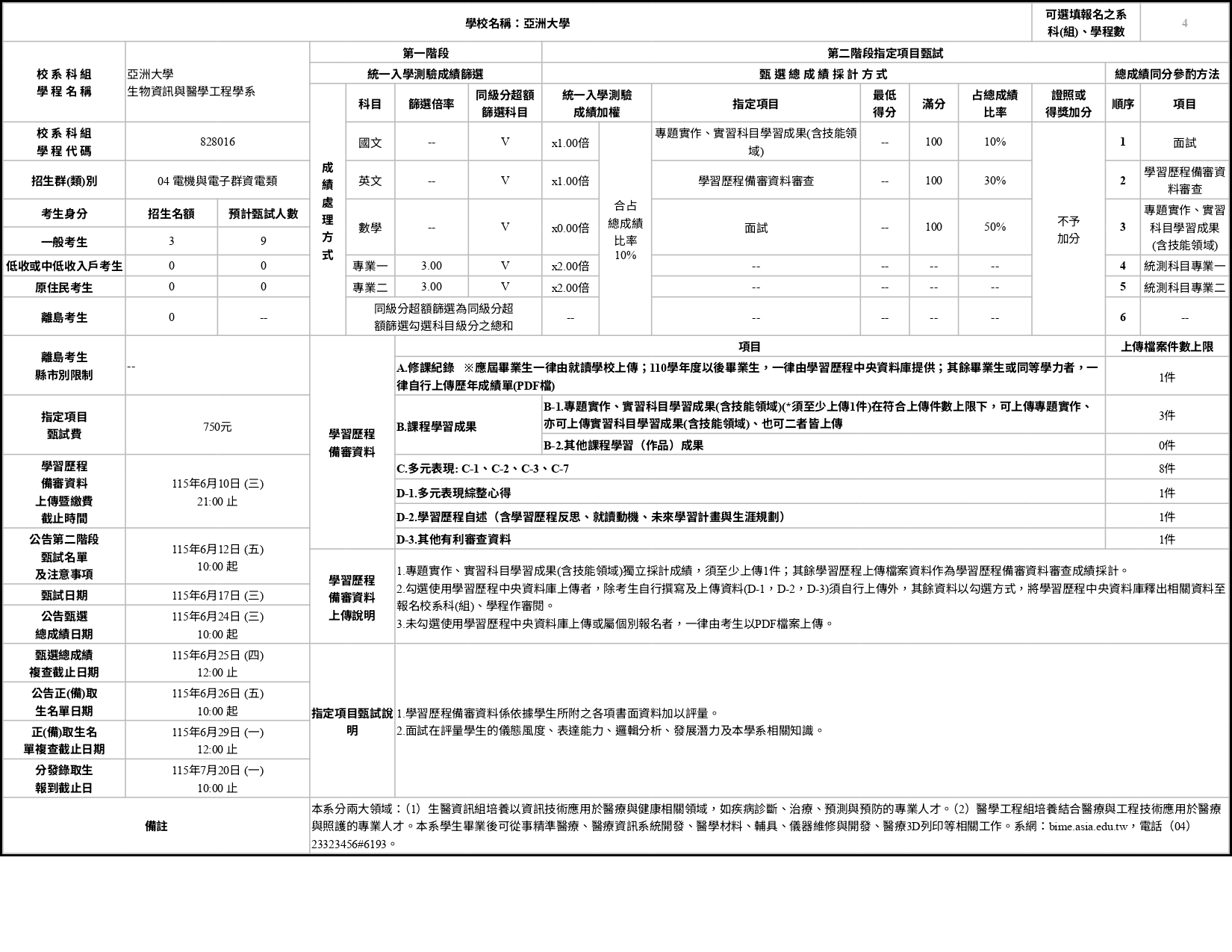
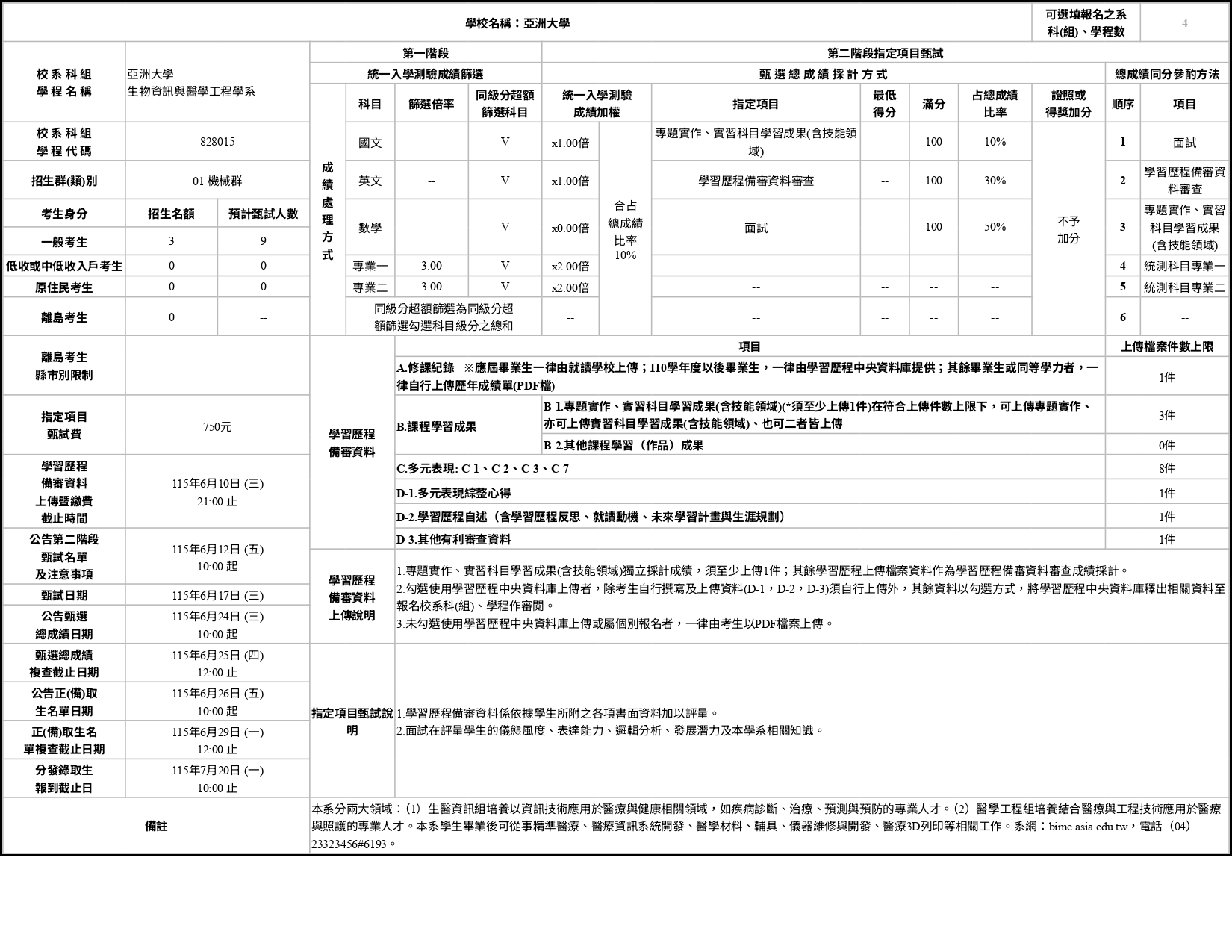
Distribution Admission · Academic Year 115
| Item | Biomedical Informatics Track | Medical Engineering Track |
|---|---|---|
| Program | Department of Bioinformatics and Medical Engineering (Biomedical Informatics Track) | Department of Bioinformatics and Medical Engineering (Medical Engineering Track) |
| Tested Subjects & Weighting | English (GSAT) × 1.00 Chemistry (AST) × 2.00 Chinese (GSAT) × 2.00 |
English (GSAT) × 1.00 Physics (AST) × 2.00 Chinese (GSAT) × 2.00 |
| Tie-Breaking Priority | 1. English (GSAT) 2. Chemistry (AST) 3. Chinese (GSAT) |
1. English (GSAT) 2. Physics (AST) 3. Chinese (GSAT) |
Department Track Descriptions
Biomedical Informatics Track: Biomedical Informatics is an innovative discipline combining medicine, biology, information technology, and management. It aims to cultivate professionals who apply information technology to health, medical, and biological data analysis, including disease diagnosis, treatment, prognosis, and prevention. Graduates can work in precision medicine, medical information systems, and healthcare software industries. Department website: bime.asia.edu.tw. Applicants satisfying Subparagraph 18 of Academic Qualifications for Distribution Admission are eligible to apply.
Medical Engineering Track: Medical Engineering is an interdisciplinary field integrating biological, clinical, and engineering technologies. It aims to foster engineering specialists who integrate biomedical technologies. Graduates can pursue careers in medical device design, medical device R&D, electronic medical instrumentation, medical 3D printing, medical equipment quality assurance, regulatory compliance, equipment maintenance, and related fields. Department website: bime.asia.edu.tw. Applicants satisfying Subparagraph 18 of Academic Qualifications for Distribution Admission are eligible to apply.
Source: Asia University Admissions Office (rd.asia.edu.tw) and the University Entrance Committee for Distribution Admission. Actual admission quotas, dates, and regulations are subject to the official admissions guide published for the given academic year.

.png)