Interdisciplinary Learning Programs
The Department offers diverse interdisciplinary learning pathways, including a double major, a minor, a cross-departmental specialty program, and field-specialty programs, encouraging students to build a second area of expertise according to their interests and career plans, strengthening their competitiveness for further studies and employment.
Interdisciplinary Learning Programs
Click a tab below to view the interdisciplinary learning application overview and the requirements and curriculum planning for the double major, minor, and cross-departmental specialty programs.
Interdisciplinary Learning Overview
The Department offers diverse interdisciplinary learning pathways, including a minor, a double major, interdisciplinary (micro-)programs, cross-departmental specialty programs, and field-specialty programs. The application periods, application items, requirements, and how each is noted on the diploma upon completion are summarized in the table below.

Double Major
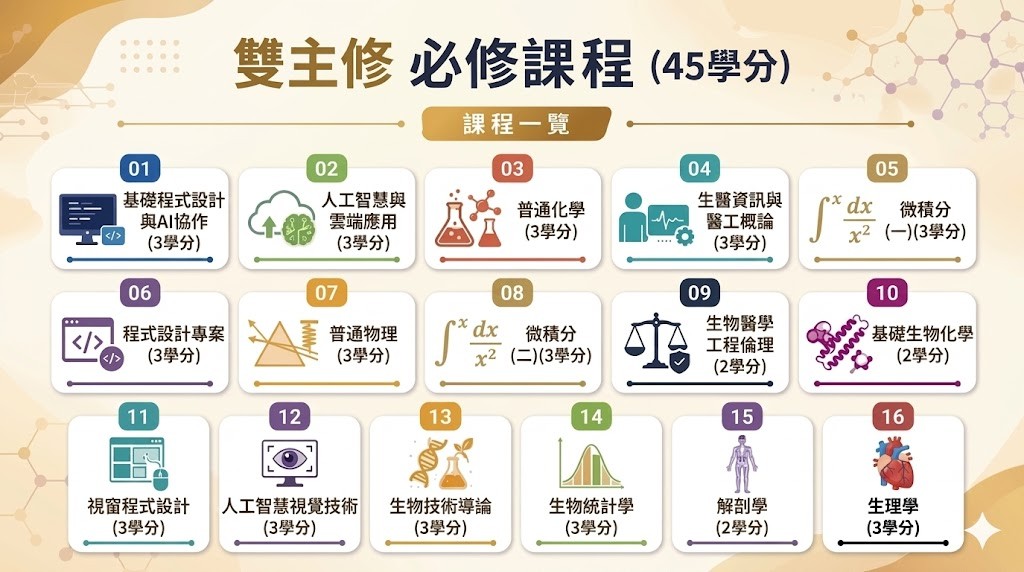
Students pursuing a double major in this Department must complete a total of 45 credits across the Department's core program and professional program, including 6 credits from the College core program and 39 credits from the Department core courses. The double major curriculum design for this Department draws on and is derived from the College core program and the Department core courses.
1Basis for These Guidelines
These guidelines are established in accordance with the University's “Regulations on Double Major Study for Students of All Departments.”
2Application Eligibility
Sophomore and junior students in any undergraduate department of the University whose academic performance in the semester prior to application ranks within the top 50% (inclusive) of their primary department's class, and who pass an interview, may apply to take this Department as their double major.
3Required Credits
In addition to fulfilling the credit requirements of their primary department, students approved to double major in this Department must further complete 9 credits of College core courses and 36 credits of this Department's core courses, for a total of 45 credits.
4Other Related Matters
Other matters related to double major study for undergraduate students of the University's departments are handled in accordance with the University's “Regulations on Double Major Study for Students of All Departments.”
5Implementation and Amendment
These guidelines take effect upon approval by the Department Affairs Meeting, and the same applies to any amendments.
Double Major Required Courses (45 Credits)
Minor
Students pursuing a minor in this Department must complete the required 20 credits set by the Department, including 20 credits of the Department's required courses. The minor curriculum design for this Department draws on and is derived from the College core program and the Department core courses.
1Basis for These Guidelines
These guidelines are established in accordance with the University's “Regulations on Minor Study for Students of All Departments.”
2Application Eligibility
Sophomore and junior students in any undergraduate department of the University whose academic performance in the semester prior to application ranks within the top 50% (inclusive) of their primary department's class, and who pass an interview, may apply to take this Department as their minor.
3Required Credits
In addition to fulfilling the credit requirements of their primary department, students approved to take this Department as a minor (“minor students”) must complete the 20 credits of required courses offered by this Department.
4Other Related Matters
Other matters related to minor study for undergraduate students of the University's departments are handled in accordance with the University's “Regulations on Minor Study for Students of All Departments.”
5Implementation and Amendment
These guidelines take effect upon approval by the Department Affairs Meeting, and the same applies to any amendments.
- Asia University Student Minor Application Form
- Official Chinese transcript of all academic years (including class rank)
Minor Required Courses (20 Credits)

Cross-Departmental Specialty Program (Applies to students admitted in Academic Years 111–113)
Students must complete at least 128 credits, including University-wide general education courses, and must also complete at least one “specialty program” offered by this Department together with either another department's “specialty program” or “interdisciplinary program,” or obtain a “secondary specialty,” before they can graduate. Any credit shortfall may be freely made up with courses from other programs besides the University-wide general education courses. A “specialty program” refers to a modularized set of courses, typically planned at 15 to 16 credits, that a department offers so that students from “other departments” can learn about one of its professional fields. A “secondary specialty” refers to a case where, although the student has not completed another department's full “specialty program,” they have completed at least three professional courses offered by that other department.
Students must complete a survey selecting another department's “specialty program” before the 14th week of the second semester of their freshman year. Students who need to change the program selected above may submit a change request directly through the Student Information System before the 14th week of the following semester.
Students from other departments taking a “specialty program” as described above have their end-of-term grades recorded on a Pass/Fail basis. Courses graded on a Pass/Fail basis are not included in the calculation of continued scholarship eligibility or semester GPA.

Field-Specialty Program (Applies to students admitted from Academic Year 114 onward)
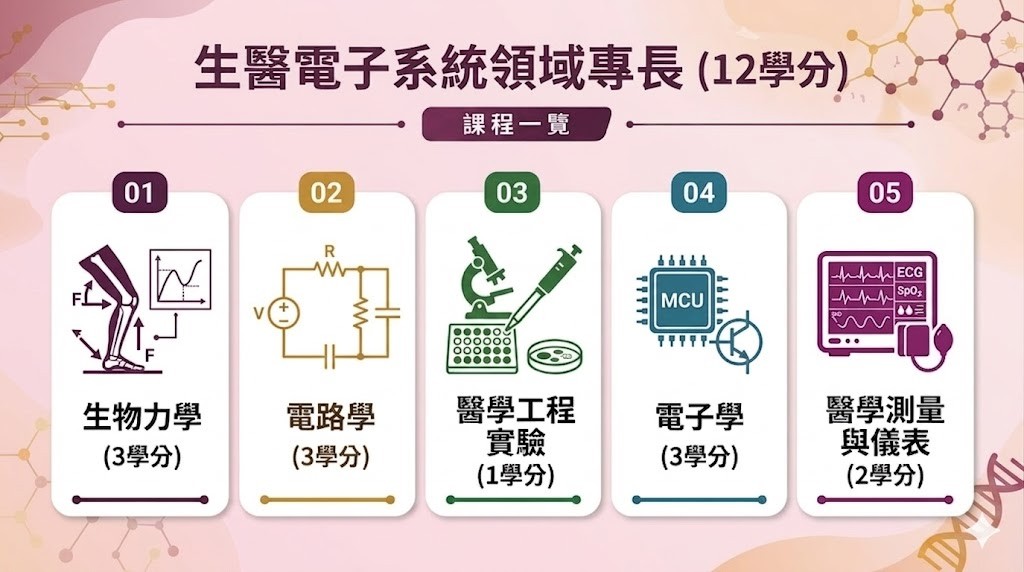
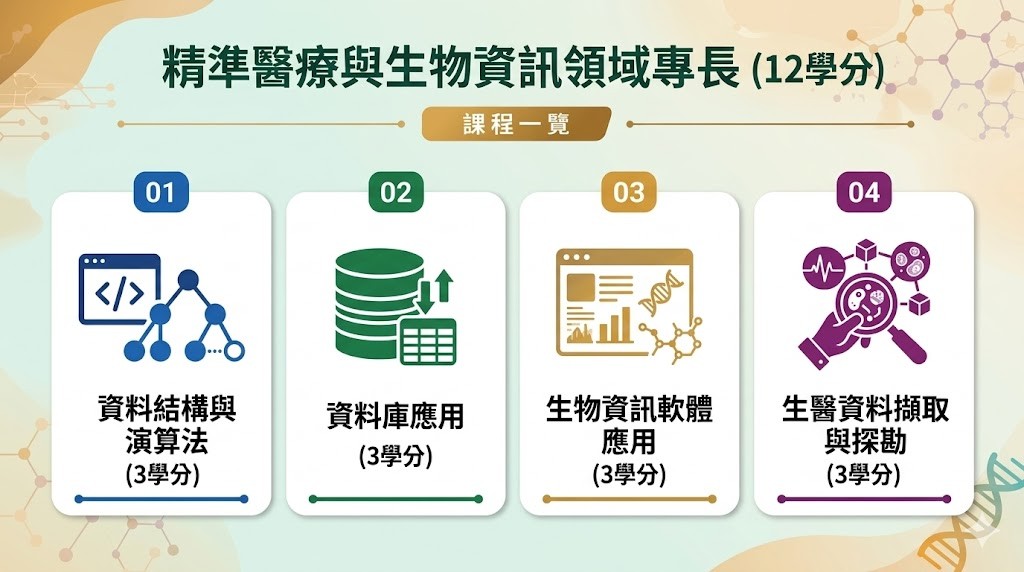
The field-specialty program curriculum for students admitted from Academic Year 114 onward is as follows, divided into two tracks — Biomedical Electronic Systems and Precision Medicine and Bioinformatics — each planned at 12 credits.

.png)