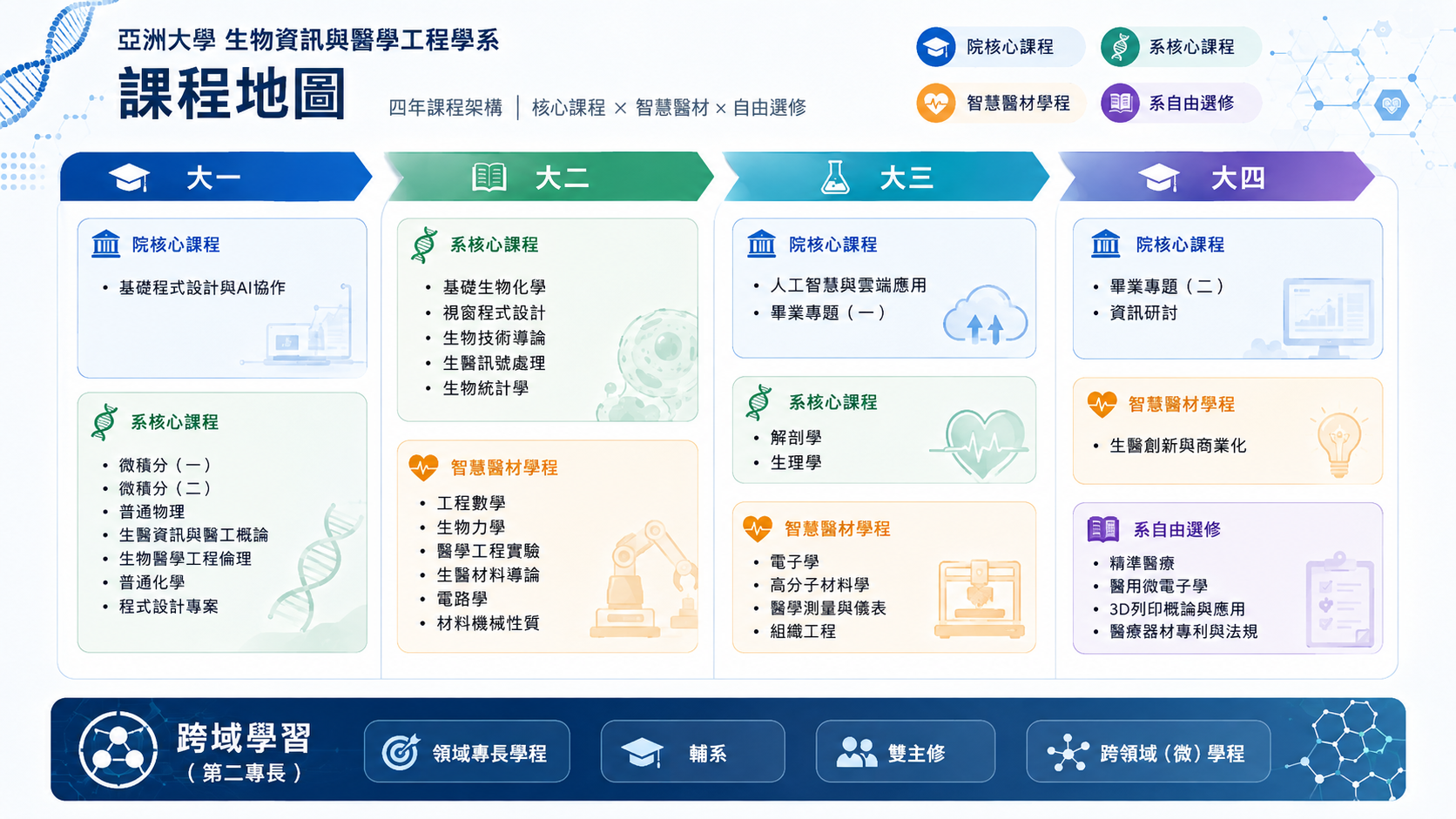
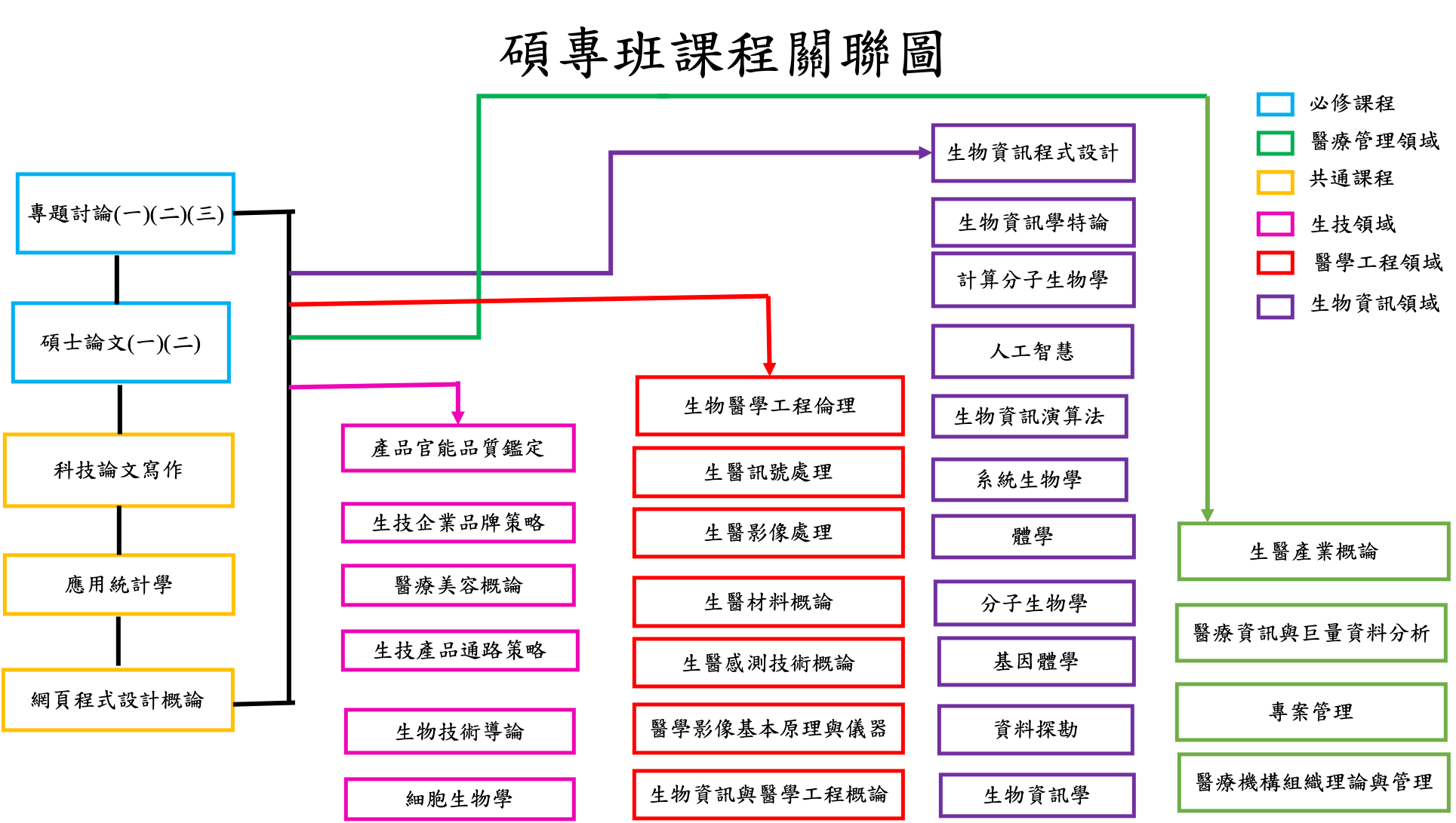
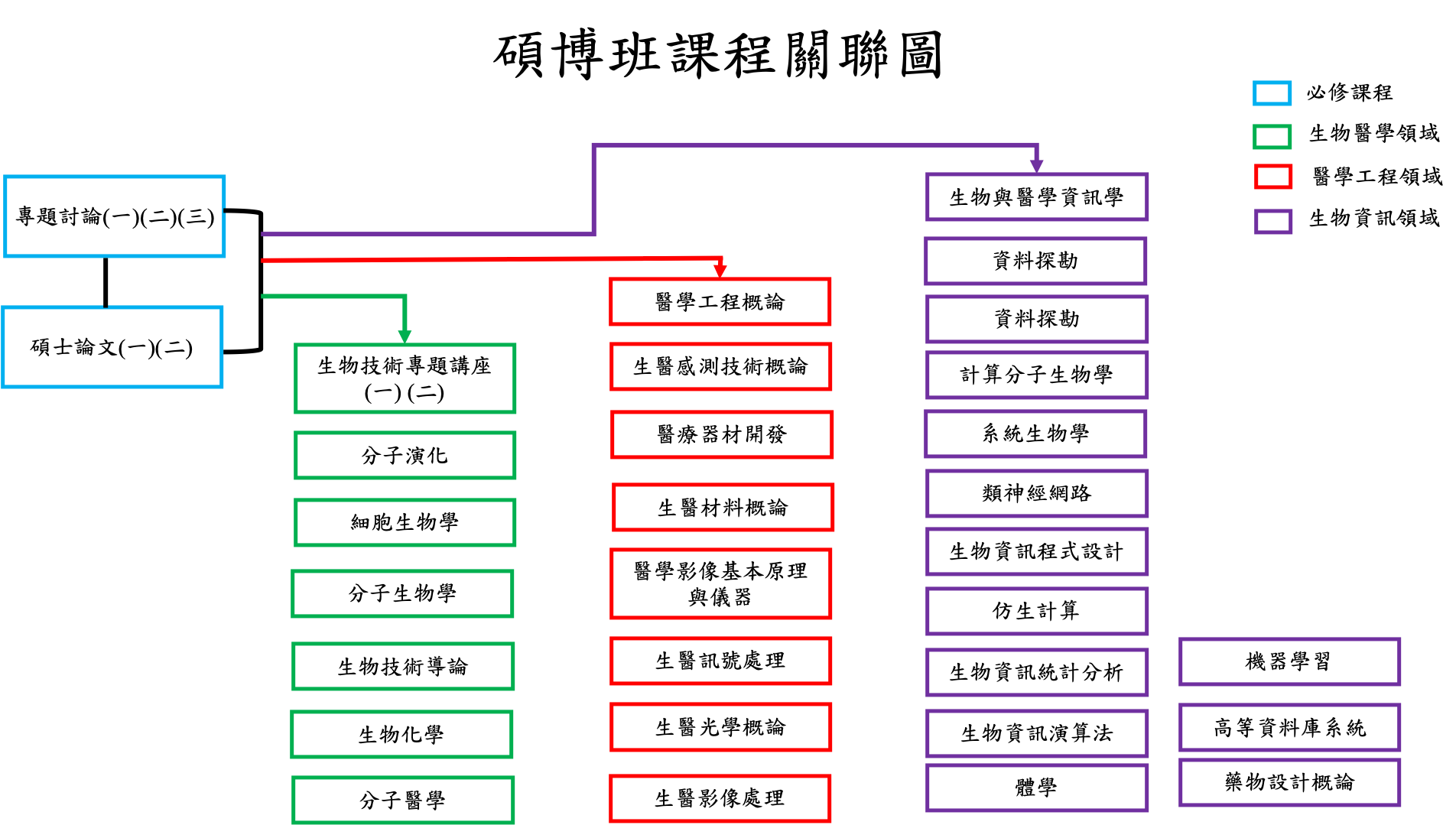
The Department has built core-competency mapping tables and course relationship diagrams for each of its five academic programs — undergraduate day program, undergraduate day program (Generative AI), master's program, executive master's program, and doctoral program — to help students understand the complete pathway connecting foundational courses, professional courses, and career outcomes.
5
Academic Programs Covered
2
Undergraduate Course Relationship Diagrams
4
Academic Years of Generative AI Course Maps
Learning Pathways
View Course Relationship Diagrams by Program
Click a tab below to view core-competency-aligned courses and the course relationship diagrams / learning maps for each program.
Ability in mathematics, information technology, engineering, and biomedical knowledge
Foundational theory and hands-on ability in experimental design and data analysis
Ability in logical analysis, programming, and use of professional tools
Ability in project management and team coordination
Ability to use and develop engineering techniques to analyze and solve related problems
Ability to keep learning new developments in biomedical informatics and biomedical engineering and to respond to trends in the field
Ability in humanities and general education, professional ethics, and social responsibility
Institute of Bioinformatics
Institute of Life Sciences
Institute of Biotechnology
Institute of Biomedical Sciences
Institute of Computer Science and Information Engineering
Biotechnology Research Assistant
Computer Programmer
Healthcare / Health Services
OCA
Medical Informatics Analyst
Medical Informatics Manager
Undergraduate Day Program (Generative AI)
113Academic Year – BIME Undergraduate Day Program Generative AI Course Map
112Academic Year – BIME Undergraduate Day Program Generative AI Course Map
111Academic Year – BIME Undergraduate Day Program Generative AI Course Map
110Academic Year – BIME Undergraduate Day Program Generative AI Course Map
Master's Program Curriculum Planning
The master's program curriculum emphasizes the development of research methodology and professional academic writing skills. Students may also select courses in biomedical informatics, medical engineering, or bioinformatics according to their interests, in preparation for further study in a doctoral program or related graduate institute.
Core Competencies / Courses
Further Studies / Courses
Careers / Courses
Ability in mathematics, information technology, engineering, and biomedical knowledge
Ability to plan and carry out research projects
Ability to write professional academic papers
Ability in innovative thinking and independent problem-solving
Ability in team coordination
International outlook and forward-looking perspective
Ability in leadership, management, and planning
Ability for lifelong self-directed learning
Ph.D. Program, Institute of Life Sciences
Ph.D. Program, Institute of Bioinformatics
Ph.D. Program, Institute of Computer Science and Information Engineering
Ph.D. Program, Institute of Biomedical Sciences
Biotechnology R&D
Academic Research
Healthcare / Health Services
Executive Master's Program Curriculum Planning
The executive master's program curriculum is oriented toward in-service continuing education. Building on the required and shared courses, students may select elective courses in fields such as biotechnology, medical engineering, bioinformatics, or healthcare management to strengthen their practical, workplace-applicable skills.
Doctoral Program Curriculum Planning
Core Competencies / Courses
Careers / Courses
Ability in mathematics, information technology, engineering, and biomedical knowledge
Ability to plan and carry out research projects
Ability to write professional academic papers
Ability in innovative thinking and independent problem-solving
Ability in team coordination
International outlook and forward-looking perspective


.png)