Our Strengths
The Department of Bioinformatics and Medical Engineering at Asia University is dedicated to cultivating interdisciplinary talent with expertise in both biological science and medical engineering technology. The Department integrates the two fields of bioinformatics and medical engineering; students learn core knowledge in genomics, protein analysis, medical data processing, artificial intelligence, and medical device design, and translate theoretical knowledge into practical application skills through lab work, capstone research, and industry-academia collaboration.
Four Teaching Strengths
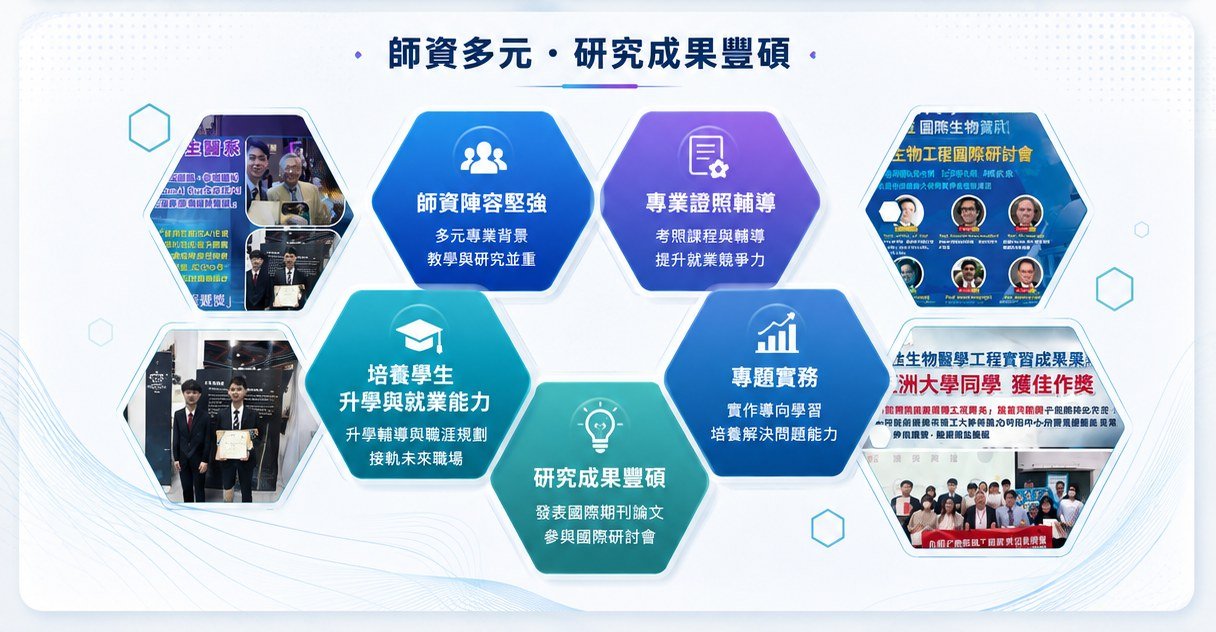
The Department offers a fully connected academic ladder, cross-disciplinary industry talent development, a strong and diverse faculty with substantial research achievements, and fully integrates artificial intelligence into teaching, creating a biomedical engineering education environment with both depth and breadth:
.png)
.png)
Four Core Development Areas
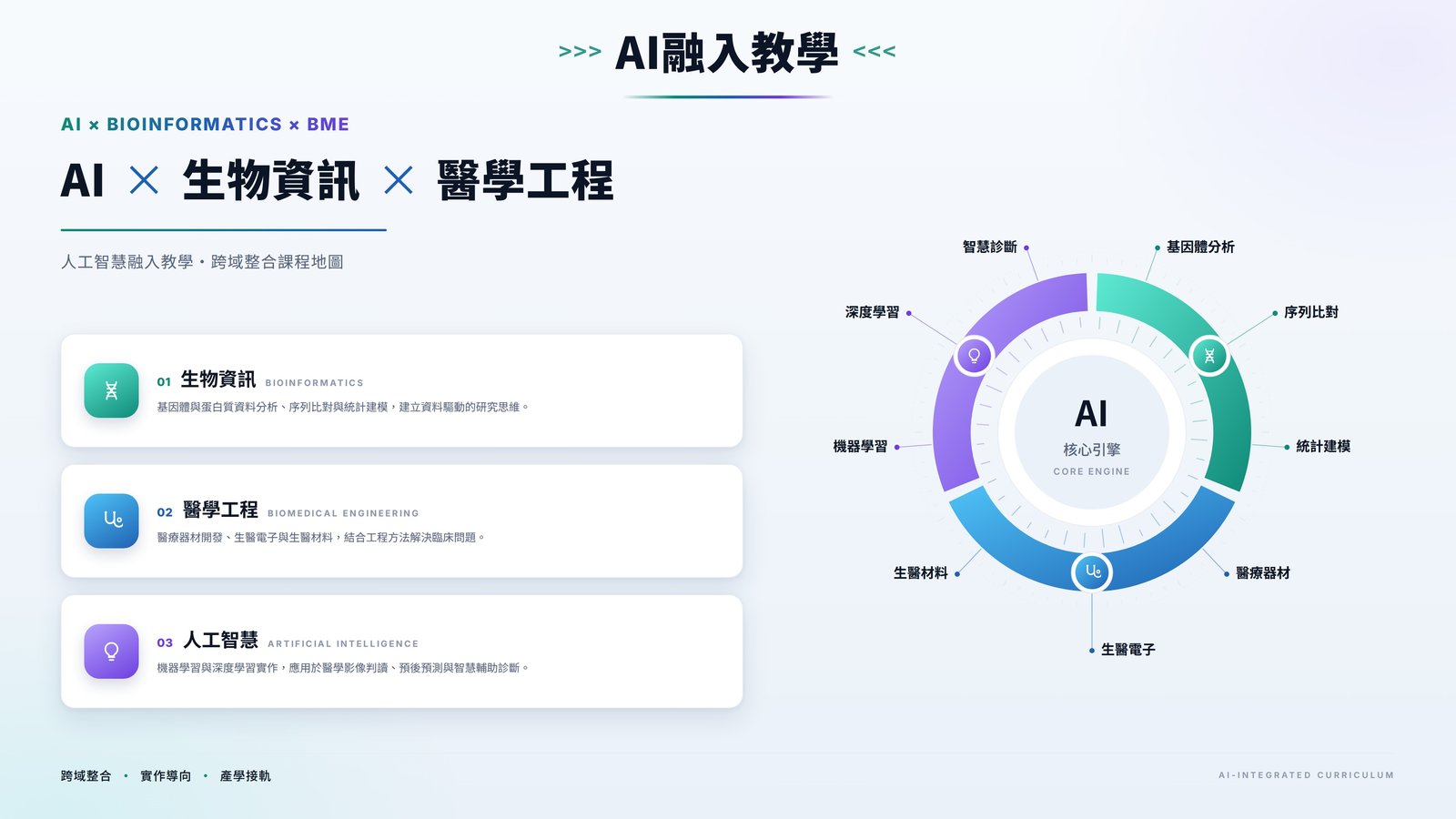
The Department focuses on AI × Bioinformatics × Medical Engineering, developing four core directions to cultivate cross-disciplinary application skills:
Bioinformatics
Bioinformatics focuses on genomics and big-data analysis, combining programming, database applications, and artificial intelligence algorithms to process genomic, proteomic, and various types of medical data. Students learn practical techniques such as building disease prediction models, analysis to support drug development, and mining of national health insurance databases, cultivating cross-disciplinary data science skills that connect to the data application needs of the precision medicine and smart healthcare industries, along with the professional ability to interpret complex biomedical information and translate it into a basis for clinical decision-making.

Precision Medicine
Precision medicine emphasizes data-driven personalized medical strategies, covering core techniques such as genomic analysis, national health insurance database applications, and drug design. Students take specialized courses in medical image analysis, microbiome research, and gene network modeling, and integrate a systems biology perspective to explore disease mechanisms. Through hands-on capstone projects and industry-academia collaboration, students build complete analytical skills from genetic information to clinical application, meeting the precision medicine industry's strong demand for cross-disciplinary talent.

Smart Healthcare
Smart healthcare combines wearable devices, biomedical electronics, and artificial intelligence technology to develop real-time physiological signal monitoring, remote care, and smart diagnostic-assist systems. Students take courses in surface plasmon sensing, biomedical photonics, and ultrasound system design, and through sensor integration and signal processing practicums, master the complete process from hardware development to data analysis, building cross-disciplinary integration and innovative R&D skills to meet the smart healthcare industry's strong demand for professional talent.

Advanced Medical Devices
Advanced medical devices focuses on innovative design and advanced manufacturing techniques for medical devices, covering the development and application of 3D-printed hydrogels, metal medical devices, ceramic medical devices, and textile medical devices. Students further study emerging fields such as cell printing, wound dressings, cosmetic products, and custom prosthesis design, participating from concept development through to actual fabrication. Through capstone practicums and industry-academia collaboration, students build the practical skills to translate theoretical knowledge into innovative clinical and industrial products.
Educational Objectives & Core Competencies | Undergraduate Program
Within three to five years of graduation, undergraduate alumni are expected to achieve the following educational objectives and possess seven core competencies:
Cultivate professional talent with expertise in engineering technology, data analysis, and biomedical knowledge
Cultivate professional talent with humanistic literacy, an international outlook, and the ability to collaborate across disciplines
Student Core Competencies (7 items)
Ability to apply knowledge of mathematics, information science, engineering, and biomedicine
Foundational theory and practical ability in experimental design and data analysis
Ability in logical analysis, programming, and the use of professional tools
Ability in project management and team coordination and collaboration
Ability to use and develop engineering techniques to analyze and solve related problems
Ability to keep learning new developments in biomedical informatics and biomedical engineering in step with the field's trends
Ability in humanities and general education, professional ethics, and social responsibility
Educational Objectives & Core Competencies | Master's, Executive Master's & Doctoral Programs
The graduate stage emphasizes leadership, management, and an international outlook, with eight core competencies:
Cultivate professional talent with expertise in engineering technology, data analysis, and biomedical knowledge
Strengthen leadership, management, and an international outlook
Graduate Student Core Competencies (8 items)
Ability to apply knowledge of mathematics, information science, engineering, and biomedicine
Ability to plan and carry out capstone research
Ability to write professional academic papers
Ability in innovative thinking and independent problem-solving
Ability in team coordination and collaboration
International outlook and forward-looking perspective
Ability in leadership, management, and planning
Ability for lifelong self-directed learning and growth

.png)